

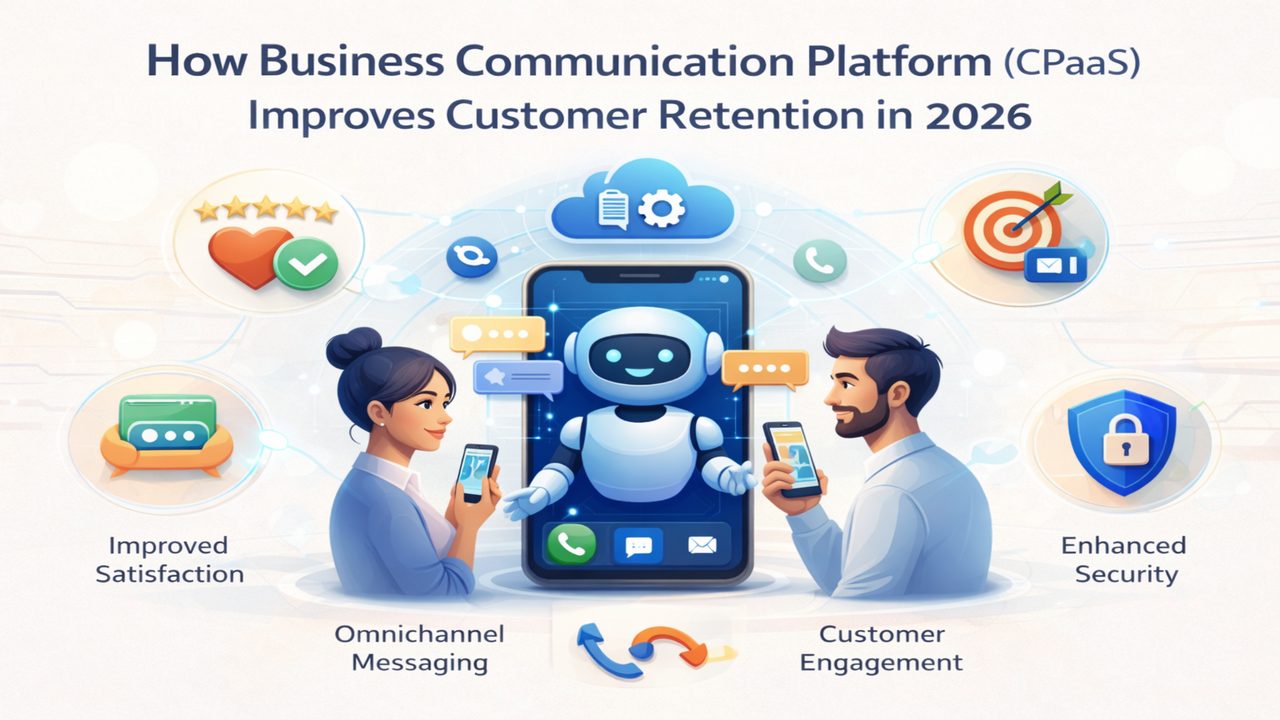
How Business Communication Platform (CPaaS) Improves Customer Retention in 2026
Retention Is the New Growth Engine in 2026
Back in 2026, customer loyalty was not just a matter of brand perception. It depended on how fast the brand responded, how personalized the communication was. the convenience of the channels used, and the consistency of the engagement.
Various enterprise data stretched across the telecom, fintech, ecommerce, and SaaS industries revealing that:
Over the last three years, the customer acquisition costs (CAC) have surged by 25-40%. In fact 68% of customers who changed brands cited poor communication experience. Meanwhile 72% of people are anticipating real, time replies on WhatsApp, SMS, voice, and email. Also, brands that respond in 5 minutes have a 21x higher chance of converting and retaining customers.
The battlefield has changed.
Customer retention is no longer a matter of manual marketing efforts, but it is the communication at the infrastructure level that matters most.
This is exactly the point where a Business Communication Solution (CPaaS) can no longer be just an option, but a necessity in 2026.
- Is it a messaging tool?
- Is it a bulk SMS dashboard?
- Is it a simple WhatsApp API connector?
A contemporary Business Communication Platform is a programmable, AI-enabled, omnichannel engagement backbone, which manages the whole customer life cycle.
Enterprises that want to be ahead of the curve are already on this path including communication-led growth providers such as Arihant Global. The latter is known for focusing on enterprise, grade, compliance ready communication ecosystems that are built for long, term customer retention rather than short term campaigns.
Retention in 2026 is something to be deliberately designed not left to chance or wishful thinking.
A Business Communication Platform (CPaaS)
A cloud-based communication platform that helps businesses embed voice, SMS, WhatsApp, RCS, email, and AI automation directly into their customer workflows, applications, and CRM systems through APIs and SDKs.
Core Architectural Components
- API & SDK Layer
- REST APIs for messaging, voice, OTP, notifications
- SDKs for web and mobile integration
- Developer-first programmable communication
- Microservices, Based Infrastructure
- Separate messaging modules
- Voice automation engines
- Chatbot orchestration layers
- Scalable cloud native architecture
- Omnichannel Orchestration Engine
- Centralized journey mapping
- Cross-channel fallback logic (SMS WhatsApp Voice)
- Context retention across channels
- AI & Automation Layer
- Chatbots driven by NLP
- Predictive churn analytics
- Behavioural triggers
- Sentiment detection
- CRM & ERP Integration
- Real-time data sync
- Automated workflow triggers
- Lead scoring + retention workflows
- Analytics & Intelligence Dashboard
- Delivery reports
- Engagement heatmaps
- Retention metrics
- LTV tracking
- Campaign ROI measurement
A Business Communication Platform turns communication from being a cost center to a measurable retention asset.
The 2026 Customer Retention Crisis
Retention is becoming more challenging due to five major changes:
1 Increasing CAC
Costs of digital advertisements have skyrocketed. Profit from paid acquisitions is dwindling. Retention is the main factor in driving profit now.
2 Multi-Channel Fragmentation
Customers use various channels to communicate:
- SMS
- Voice
- RCS
- App notifications
Without a unified Business Communication Platform brands lose the flow and understanding of the situation.
3 Response Windows are Getting Shorter
According to a forecast for 2026:
- Customers on chat will expect replies within a minute
- If replies are late customers’ trust and willingness to engage again will decrease
4 AI Expectation
Nowadays customers expect smart and relevant answers instead of standard and rehearsed ones.
5 Regulatory Compliance (India Focus)
As per TRAI & DLT:
- Consent management is a must
- Template approval is necessary
- Segmentation
7 Advanced Ways a Business Communication Platform Improves Customer Retention
1. Omnichannel Engagement Consistency
- Problem: Customers experience different types of communications on various channels.
- Strategic Solution: A centralized Business Communication Platform harmonizes customer communication from WhatsApp, bulk SMS, voice, and email with journey orchestration.
- Enterprise Example: A fintech brand sends onboarding messaging over WhatsApp. When undelivered, fallback SMS automatically triggers.
- Outcome: 28% increase in onboarding completion 18% improvement in retention over 90 days
2. AI-Powered Response Automation
- Problem: Manual support increases waiting time and leads to customer churn.
- Solution: AI chatbots + smart routing embedded in the platform.
- Example: The healthcare provider uses a WhatsApp Business chatbot to automatically reschedule appointments.
- Outcome: 40% decrease in customer support requests 22% growth in repeat bookings
3. Behavioural Triggered Messaging
- Problem: Sending the same message to all results in fewer engagements.
- Solution: Real-time events based triggers sourced from CRM data.
- Example: Online retailer sends cart abandonment email 15 minutes after the action.
- Outcome: 35% of carts recovered 17% rise in customer purchasing frequency
4. Smart IVR & Voice Automation
- Problem: Old IVR system disappoints customers.
- Solution: AI-powered voice bots that also have access to CRM are combined.
- Example: Financial services firm introduces voice authentication + contextual routing.
- Outcome: 30% quicker problem resolution 19% higher customer satisfaction score
5. WhatsApp Conversational Commerce
- Problem: Customers quit the checkout process due to a lack of ease.
- Solution: Embedding payments + support in WhatsApp Business API.
- Outcome: 24% boost in the conversion rate 15% increase in customer retention
6. Proactive Churn Detection Using Analytics
- Problem: Most businesses find out about churn when it has already happened.
- Solution: Best Business Communication Platform predictive analytics brings to light low engagement patterns.
- Example: EdTech platform notices the decline in login frequency retention campaign is launched.
- Outcome: 26% drop in churn
7. Lifecycle-Based Retention Campaigns
From onboarding → engagement → upsell → loyalty → reactivation.
Structured lifecycle automation increases LTV by 20–35%.
India Specific Compliance & Retention Protection
A Business Communication Company in India Shall Comply With:
- TRAI Regulations Compliance
- Header registration
- Template approval
- Scrubbing mechanisms
- DLT Registration
- Entity & telemarketer registration
- Real-time DLT validation
- Consent Management
- Opt-in tracking
ROI & Business Impact Analysis
Enterprises implementing a unified Business Communication Platform report:
| Metric | Improvement Range |
| Retention uplift | 15–30% |
| Churn reduction | 20–35% |
| Faster resolution time | 25–40% |
| Repeat purchase rate | +18% |
| Support cost reduction | 30% |
| LTV/CAC improvement | 25% |
Retention directly improves revenue predictability.
Traditional Tools vs Modern Business Communication Platform
| Traditional Approach | Modern Platform |
| Manual campaigns | Automated lifecycle journeys |
| Single channel | Omnichannel orchestration |
| No analytics | Predictive insights |
| Reactive support | Proactive retention |
| Limited scalability | Cloud-native scaling |
Manual outreach cannot compete with intelligent automation in 2026.
Why Retention-Focused Infrastructure Wins
A Business Communication Platform is:
- Business infrastructure for revenue
- Retention engine
- AI-powered growth mechanism
- Compliance safeguard
- Data intelligence component
Companies that consider communication as an infrastructure, rather than marketing, are ahead of their competitors. Leading companies are going for well planned, scalable communication systems via providers like Arihant Global that allow them to unify engagement, have measurable ROI, and retention strategies in compliance with the law.
Final Strategic Insight
In 2026, customer retention will not be through discount or loyalty points.
Customer retention will be through:
- Speed
- Personalization
- Context
- Compliance
- Automation
- Data intelligence
Business Communication Platform is crucial for the alignment of these six elements.
Companies that install infrastructure level communication systems are essentially setting up their revenue, generated engines which can be both scalable and predictable. Those who don’t in fact, will continue down the path of losing customers.
If you, as an organization, are really determined to cut down churn, raise LTV, and set up smart customer engagement ecosystems it is a call to map out retention through a scalable Business Communication Platform instead of isolated tools.
Frequently Asked Questions (SEO Optimized)
- How does a Business Communication Platform help to retain customers?
By providing omnichannel engagement, automation, AI powered personalization, and instant communication workflows.
- How is CPaaS different from traditional messaging tools?
CPaaS allows programmable APIs, automation, analytics, and integration whereas messaging software is a standalone solution.
- Can a Business Communication Platform decrease churn?
Definitely. Churn can be cut by up to 35% when predictive analytics and lifecycle automation are used.
- Is TRAI compliance compulsory in India?
Absolutely. For SMS communication, DLT registration and template approval are required.
- What industries stand to gain the most from CPaaS?
Industries such as fintech, healthcare, ecommerce, EdTech, and real estate.
- Is WhatsApp API included in a Business Communication Platform?
It is. It is part of the omnichannel communication architecture.