
Enterprise Communication Solutions: Why Big Companies Keep Buying Tools That Don’t Fix the Problem
Discover why enterprise communication projects fail, the difference between Unified Communications and Enterprise Communication Solutions, and how to build a scalable communication infrastructure that improves collaboration, compliance, and business performance.
A CTO at a mid-sized manufacturing company in Pune sat across from me last quarter, visibly tired. His company had spent ₹2.3 crores over three years chasing enterprise communication solutions – video conferencing, team messaging, an email upgrade, a ticketing system, an abandoned vendor portal. Six tools, forty-seven departments, three thousand employees. Yet the top complaint in their culture survey hadn’t moved: “we don’t know what’s happening in other teams.”
He wasn’t surprised. He was exhausted. People were deciding on three-day-old information, sending one update across three platforms since nobody knew who’d see it, and holding meetings to share what should’ve arrived as a notification. That’s not a technology failure. it’s a strategy failure wearing a tooling problem’s clothes, the exact pattern across organizations evaluating enterprise communication solutions today. Leadership teams keep buying every enterprise communication platform available and still can’t answer:
what’s happening across the business right now?
The Real Problem Behind Failed Enterprise Communication Solutions
Before recommending any solution, it’s worth being precise about what enterprise communication problems actually look like because the symptoms are often visible while the root causes stay hidden.
The most common patterns that signal a broken Enterprise communication infrastructure:
1. Information asymmetry between departments
sales doesn’t know what operations committed to a client, customer support doesn’t know what SMS marketing promised in a campaign, leadership is making decisions based on reports that were accurate two weeks ago
2. Tool proliferation without integration
WhatsApp groups running parallel to official channels because the official channels are too slow, spreadsheets being emailed back and forth because the enterprise system is too complicated to update quickly, shadow workflows built outside sanctioned tools because the sanctioned tools don’t actually fit how work gets done
3. Meeting load as a communication failure signal
when an organization schedules meetings to share information that should travel asynchronously, it’s almost always because the a sync enterprise communication infrastructure is broken or distrusted
4. Compliance and audit trail gaps
regulated industries where critical decisions are being made in informal channels personal WhatsApp, verbal conversations, undocumented calls creating legal and operational exposure nobody has formally mapped
5. Onboarding friction
new employees spending their first two to four weeks learning which tool is actually used for what, because the official guidance and the real behaviour diverged years ago and nobody updated the documentation
None of these are solved by a new platform licence. They’re solved by an honest diagnosis of how Business communication actually flows in the organization today not how the org chart says it should flow followed by an architecture decision that matches the real workflow, not the idealized one.
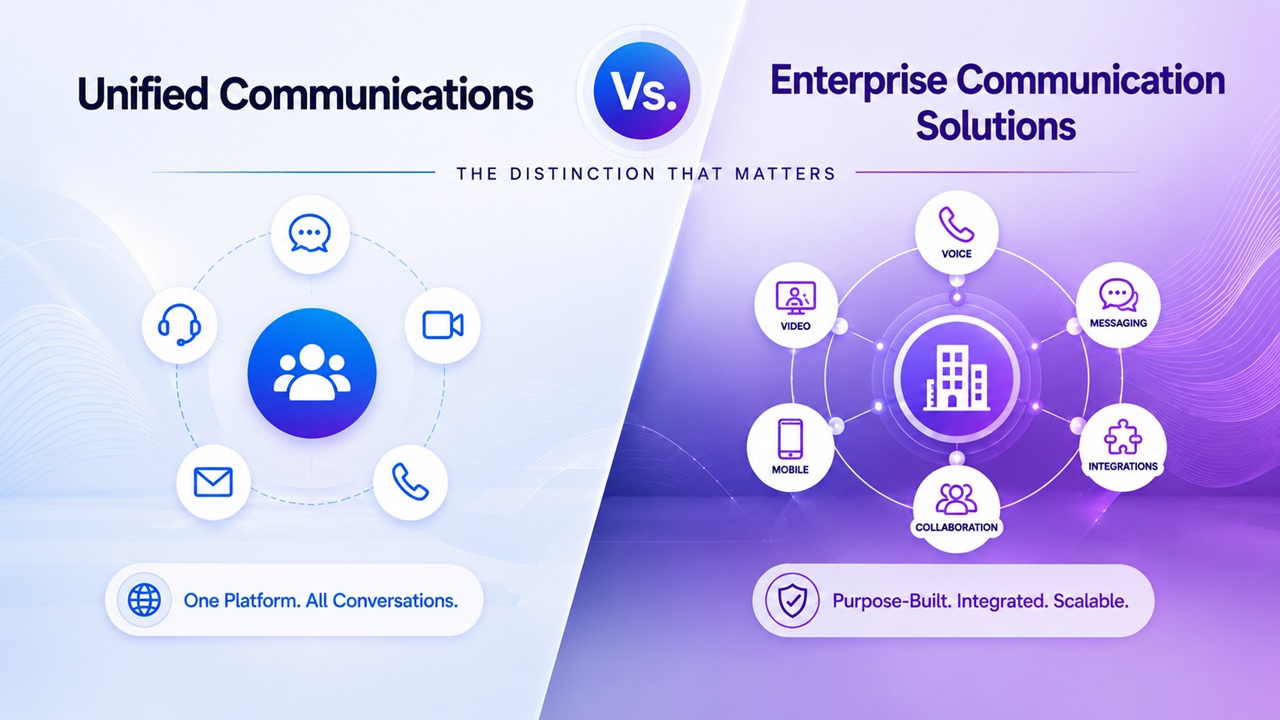
Unified Communication vs. Enterprise Communication Solutions: The Distinction That Matters
These two terms get used interchangeably in vendor pitches. They’re not the same thing, and conflating them is how Organizations end up buying the wrong category of solution.
Unified Communication (UC)
Unified Communication is a technology category specifically, the integration of voice, video, messaging, and collaboration tools into a single platform or connected suite. Microsoft Teams, Cisco Webex, Google Workspace. UC is about consolidating the tools employees use to talk to each other. It’s primarily an internal productivity and collaboration play.
Enterprise Communication Solutions
Enterprise communication is a broader category that encompasses internal collaboration, but also includes external-facing communication customer interactions, vendor relationships, partner communications, and the data infrastructure that makes all of those conversations contextually intelligent rather than isolated transactions. A genuine Enterprise communication Platform doesn’t just make internal meetings easier. It connects the internal communication layer to the external one, so what the customer said to support this morning is visible to the account manager in the afternoon’s renewal call.
Feature |
Unified Communications (UC) |
Enterprise Communication Solutions (ECS) |
|
Primary Focus |
Internal team communication |
Organization-wide communication ecosystem |
|
Purpose |
Simplify employee collaboration | Connect employees, customers, partners, and vendors |
| Communication Channels | Voice, video, chat, email |
Voice, video, chat, SMS, WhatsApp, RCS, email, social media, APIs |
|
Target Users |
Employees and internal teams | Employees, customers, suppliers, partners, and stakeholders |
|
Scope |
Internal collaboration |
Internal + external business communication |
| Integration | Collaboration and productivity tools |
CRM, ERP, HRMS, Helpdesk, CPaaS, AI, and business applications |
|
Customer Engagement |
Limited |
Core functionality with omnichannel engagement |
|
Automation |
Basic workflows |
AI-powered automation, chatbots, notifications, and workflow orchestration |
|
Scalability |
Team and departmental level | Enterprise-wide, multi-location, and global operations |
| Compliance & Security | Standard enterprise security |
Advanced governance, audit trails, compliance, and role-based access |
|
Business Goal |
Improve employee productivity | Improve communication, customer experience, and business operations |
| Best For | Small to medium organizations |
Medium to large enterprises with complex communication needs |
|
Examples |
Microsoft Teams, Zoom, Cisco Webex, Google Workspace |
CPaaS platforms, omnichannel communication platforms, enterprise messaging solutions integrated with CRM & ERP |
What Enterprise Communication Infrastructure Needs to Deliver in 2026
The bar for enterprise-grade communication has moved. Here’s what modern enterprise communication Infrastructure need to get right:
1. Asynchronous-first design
in multi-time zone organizations, infrastructure that demands synchronous presence creates bottlenecks at every handoff. synchronous channels should be reserved for decisions that genuinely need real-time input
2. Contextual intelligence at every touchpoint
previous conversations, related documents, and open action items should surface automatically, not require someone to go hunting before they can respond
3. Compliance built in, not bolted on
for BFSI, healthcare, and pharma, communication records aren’t optional enterprise communication Infrastructure must capture, store, and make every relevant interaction searchable, with access controls that satisfy regulators and daily operations alike
4. Integration with existing systems
ERP, CRM, HRMS. A Cloud communication platform that exists as an island beside the systems where actual business data lives recreates the exact information asymmetry it was bought to solve
5. Governance for tool adoption
the most capable Cpaas platform fails without a governance model defining which tool carries which type of communication, enforced through training and process design
How Arihant Global Builds Enterprise Communication Solutions
Enterprise communication engagement fail most often not at vendor selection but at implementation. when the gap between how a platform was designed to work and how the organization actually operates becomes visible, with no plan to close it. Our model is built specifically to close that gap, in six phases:
1. Communication Landscape Audit
mapping reality, not aspiration, tool usage patterns, shadow workflows, and a full inventory of every communication-adjacent licence, used or not.
2. Information Architecture & Flow Design
defining who needs to know what, when, and through which channel, mapped across internal collaboration, cross-department coordination, leadership broadcast, and external communication.
3. Solution Architecture & Vendor Evaluation
a single unified Communication platform, a best-in-class combination connected through middleware, or simply better governance of existing tools, evaluated against your actual requirements, not a generic checklist.
4. Implementation & Integration
technical rollout, ERP/CRM/HRMS integration, and the workflow redesign most projects skip meeting norms, async standards, escalation protocols.
5. Change Management & Adoption
the most underinvested phase anywhere. Adoption happens because people understand why the old way is being replaced, not because the tool is good.
6. Performance Measurement & Optimization
tracked against the fragmentation cost identified in Phase 1: meeting load, decision cycle time, cross-department response time, compliance coverage. Most engagements run 10–12 weeks from audit to a fully adopted system, with performance measurement continuing quarterly after that. The timeline matters less than the sequencing skipping straight to Phase 3 without Phases 1 and 2 is exactly how organizations end up buying enterprise communication solutions that look right on paper and fail in practice.
Where Enterprise Communication Failures Cost the Most
Every large organization suffers some communication fragmentation, but the cost is sharpest and most measurable in sectors where information delay translates directly into money, compliance risk, or safety:
- Manufacturing & Supply Chain – a 24-hour information lag between procurement, logistics, and sales can cascade into real operational and financial loss across an entire production cycle
- BFSI – regulatory compliance demands complete audit trails of specific communication categories, and informal channels create genuine legal exposure that’s expensive to unwind after the fact
- Healthcare & Pharmaceuticals – communication failures carry direct patient-safety implications alongside strict access governance needs across clinical and administrative teams alike
- IT & Technology Services – distributed, multi-timezone teams turn weak async infrastructure into constant context-switching, meeting overload, and delayed delivery cycles
- Real Estate & Infrastructure – large cross-functional teams and multiple external vendors mean information gaps translate directly into cost overruns and timeline slippage
Questions to Ask Any Enterprise Communication Platform
Vendor demos are designed to show the best-case scenario, which is exactly why the right questions matter more than the feature list. Ask any enterprise communication solutions provider these directly, and watch how specifically they answer:
- How does the platform integrate with legacy infrastructure that can’t be switched off immediately, rather than forcing a full replacement?
- What does compliance and data residency look like under India’s Digital Personal Data Protection Act?
- What’s your documented adoption rate at organizations our size, ninety days post-implementation not Cpaas platform capability, actual human usage?
- Who decides which communication belongs on which channel, and how is that enforced without creating a surveillance culture?
Governance without trust destroys adoption faster than any feature gap does. A vendor who can’t answer the adoption question with real numbers is selling you a platform, not a solution.
The Sectors Where Enterprise Communication Failures Are Most Expensive
Every large organization suffers from communication fragmentation. But the cost is highest and most measurable in specific sectors:
1. Manufacturing & Supply Chain
where production decisions depend on real-time information from procurement, logistics, and sales, and a 24-hour information lag in any of those functions can cascade into significant operational and financial loss.
2. Banking, Financial Services & Insurance (BFSI)
where regulatory compliance requires complete audit trails of specific categories of communication, and where informal channels creating undocumented decision records represent genuine legal exposure.
3. Healthcare & Pharmaceuticals
where clinical and operational communication failures have direct patient safety implications, and where the volume and sensitivity of information flowing across departments requires both clarity and strict access governance.
4. IT & Technology Services
where distributed teams across geographies and time zones create coordination complexity that poor async communication infrastructure turns into constant context-switching, meeting overload, and delayed delivery cycles.
5. Real Estate & Infrastructure
where projects involve large, cross-functional teams, multiple external vendors, and long decision cycles where information gaps between stakeholders create cost overruns and timeline slippage.
FAQ – Enterprise Communication Solutions
1. What is an enterprise communication solution?
An enterprise communication solution is the full communication ecosystem connecting employees, customers, vendors, and partners spanning voice, video, chat, SMS, WhatsApp, RCS, and email integrated with CRM, ERP, and HRMS so information flows as one connected system rather than isolated conversations across separate tools.
2. Why do large organizations need one instead of just team collaboration tools?
Team collaboration tools like Teams or Webex handle internal talk well but stop at the company’s edge. Once customer interactions, vendor communication, and cross-departmental handoffs need to share context. what a client told support, visible to the account manager later internal-only tools stop being enough, and that’s the gap an enterprise communication solution closes.
3. How much does an enterprise communication solution cost?
Cost depends on organization size, number of integrations (CRM/ERP/HRMS), and whether it’s a single unified platform or several best-in-class tools connected through middleware. which is why a proper audit and architecture phase usually comes before any pricing discussion, rather than a flat per-seat quote.
4. Who is responsible for enterprise communication within a company?
Usually IT or operations leadership owns the platform decision, but adoption succeeds only when department heads help define which channel carries which type of communication governance without that cross-functional buy-in is the most common reason implementations fail within ninety days.
5. Is enterprise communication software the same as CRM software?
No. CRM manages customer relationship data and sales pipeline. an enterprise communication solution is the messaging and channel layer that feeds real-time context into CRM (and ERP, HRMS) so that data reflects what’s actually being said across every conversation, not just what’s logged after the fact.
One Thing You Can Do Today
If you’re currently evaluating communication infrastructure for a large organization whether you’re starting from scratch, rationalizing an over-tooled environment, or trying to understand why a recent implementation hasn’t produced the adoption it was supposed to Arihant Global’s audit is the right first conversation. It clarifies the actual problem before any technology decision gets made, and that clarity is usually worth more than the engagement itself.
Transform Your Enterprise Communication with Arihant Global
Disclaimer
This article is for informational purposes only. Communication strategies and technology recommendations should be evaluated based on your organization’s specific business and compliance requirements. For tailored enterprise communication solutions, consult Arihant Global.