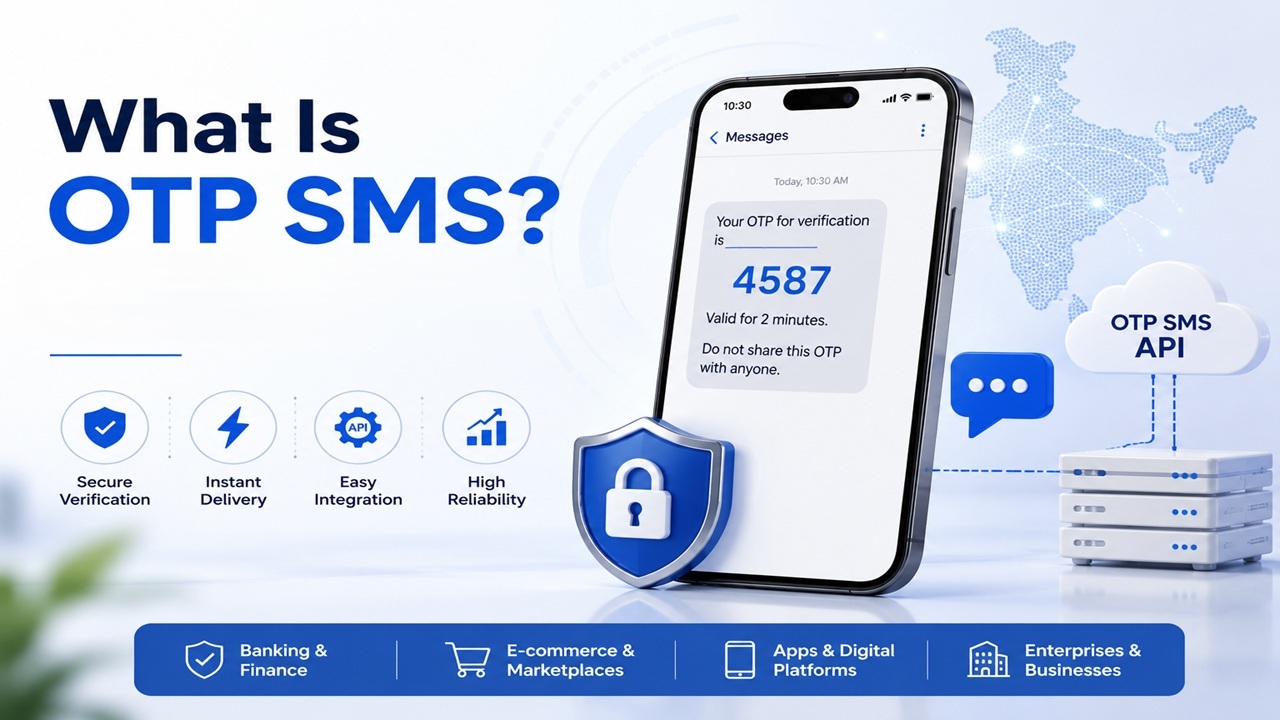
What Is OTP SMS? Best OTP SMS API Provider in India for 2026
For years I assumed OTP was the boring part of the stack. The solved problem. Integrate it once, forget about it, move on.
Then a payments founder in Pune called me on a Sunday afternoon never a good sign and walked me through six weeks of declining transaction success rates. His team had investigated the payment gateway, bank integrations, frontend performance. Had three theories. None correct.
It was OTP delivery. Specifically, the 7pm to 9pm window, when volume was highest and the shared SMS pool was most congested. Average delivery time had quietly climbed past 45 seconds. His expiry window was 40 seconds. Every “delivered” OTP SMS was arriving after the session had already closed.
Six weeks. Completely invisible on the dashboard. That’s what OTP failure looks like when it’s being polite.
What Actually Is OTP SMS?
OTP stands for One-Time Password. It’s a single-use authentication code usually four to six digits sent to a user’s registered mobile number to verify their identity or authorize a specific action.
The basic flow works like this:
- User initiates an action requiring verification login, payment, account recovery
- Business system generates a unique code with a defined expiry window
- Code passes to an SMS gateway via API call
- Gateway routes the message through telecom operator networks
- Code arrives on the user’s handset
- User enters the code before it expires
- Authentication completes, action proceeds
Simple in description. Genuinely complex in execution at scale across India’s diverse network infrastructure.
The reason OTP SMS matters so much in 2026 specifically is that it sits directly on the transaction path for almost every digital business in India fintech, e-commerce, healthcare platforms, edtech, logistics, banking. Every user verification, every payment authorization, every login. If OTP SMS delivery is unreliable, every one of those flows is unreliable. The business impact isn’t abstract. It’s immediate and measurable in abandoned transactions and lost users.
The Specific Ways OTP SMS Fails in India
Understanding failure modes is more useful than understanding success metrics because failure is what you’re actually trying to prevent.
Shared pool congestion
is the one that causes the most damage at scale. A bulk SMS provider in India serving hundreds of clients routes all of that traffic your time-critical authentication OTPs, someone else’s promotional campaign, another company’s transactional alerts through shared infrastructure. When promotional volume spikes, the pool gets congested. Your OTP waits. The user doesn’t.
DLT template mismatch
TRAI’s Distributed Ledger Technology framework requires every commercial SMS template to be pre-registered and approved. The deployed message must match the registered template exactly within defined variable fields. Development teams change things add a variable, adjust wording for a new feature, shorten the message for a different flow. Nobody re-registers the template because nobody remembers the process from a year ago. Messages get silently blocked at the operator level. The provider dashboard shows delivered. The user sees nothing.
Latency beyond the expiry window
is the invisible one the failure mode that produced the Pune story I opened with. Delivery confirmed. Code expired. Transaction failed. Completely invisible on standard delivery rate reporting.
No intelligent fallback
means a single operator pathway with nothing behind it. When it degrades maintenance window, traffic spike, operator-level filtering the business discovers the problem through customer complaints.
Missing Voice OTP
means users in low-signal areas, on older handsets, or with full SMS inboxes have no alternative path to authentication. For a significant portion of India’s internet users, that’s not an edge case. It’s a consistent reality.
The Metric That Changes How You See Your OTP SMS Performance
Every OTP SMS API provider in India will show you a delivery rate. Most of them are showing you the wrong number.
Standard delivery rate measures gateway-to-operator acceptance. The telecom operator acknowledged receipt of the message from the gateway. That acknowledgement is what shows as “delivered” on the dashboard. What happens between that moment and the message appearing on a user’s screen in Varanasi at 8pm is not in that number.
Time-Bound Delivery Rate TBDR is the number that actually reflects what users experience. It measures what percentage of OTPs reach the handset within 15 seconds of the API call, at the network level.
Why 15 seconds? Because that’s genuinely how long most users actively watch their phone after clicking “send OTP SMS” before doing something else. Clicking resend. Assuming the platform is broken. Closing the app. An OTP arriving at second 22 on a 30-second expiry window might complete successfully. An OTP arriving at second 32 is a failed authentication regardless of what the delivery dashboard says.
Pull TBDR filtered by hour specifically 10am to noon and 6pm to 9pm, your peak transaction windows. Compare those numbers to your overnight figures. In most Indian businesses running on shared SMS infrastructure, the gap is significant. Those peak-hour drops are your actual OTP performance during the moments that matter most to revenue.
Voice OTP API: The Part of the Architecture Most Businesses Defer Too Long
I’ve had this conversation so many times I could script it.
Me: does your OTP SMS infrastructure include Voice OTP fallback?

Client: it's on the roadmap. Me: when does it ship? Client: after we stabilize the current stack.
Six months later they call back because a specific user segment usually non-metro, usually older devices, usually the segment with some of their highest average order values has been quietly failing authentication at a rate nobody caught until it was significant.
Voice OTP API delivers the authentication code as an automated voice call. Text OTP dispatches first. If handset-level delivery confirmation doesn’t return within 20 to 25 seconds, a voice call triggers automatically. The user hears the code clearly, twice. Authentication completes. Session stays live. From the user’s perspective the experience was slightly different from usual. From the business perspective a conversion was saved that would otherwise have been lost.
For users in Tier-2 and Tier-3 geographies Coimbatore, Jodhpur, Guwahati, hundreds of cities with real spending power and genuine transaction volume SMS delivery has never been as reliable as it is in a Mumbai office building. Voice OTP isn’t a contingency for those users. It’s the more reliable primary channel. Businesses that acknowledge this in their architecture see measurably better authentication completion in those segments.
How Arihant Global Builds OTP SMS Service Infrastructure
Phase 1 – Authentication Audit (Week 1)
Every OTP touchpoint mapped across the product login, checkout, account recovery, transaction confirmation, onboarding verification. Current routing setup, session expiry window, peak traffic volume, existing fallback documented for each touchpoint. Most businesses find two to four touchpoints with no fallback and no delivery monitoring configured.
Deliverables: full touchpoint map, latency requirement per flow, delivery gap analysis.
Phase 2 – Architecture and Route Design (Week 1–2)
Routing structure built from actual requirements primary SMS route, secondary fallback, Voice OTP trigger logic, DLT-compliant template structure for every message variant. Tier-2 and Tier-3 coverage assessed independently because routing decisions that serve Bengaluru don’t automatically serve Bhubaneswar.
Deliverables: routing architecture, Voice OTP integration specification, DLT compliance checklist.
Phase 3 – DLT Registration and Compliance (Week 2, parallel)
Full DLT Registration across Airtel, Jio, Vi, BSNL. Sender ID verification. Template library reviewed against actual deployed messages template drift almost always surfaces here. Re-registration where gaps exist. Template management process built into the development workflow so future product changes trigger compliance steps automatically.
Deliverables: DLT compliance confirmation, updated template library, change management documentation.
Phase 4 – OTP SMS API Integration and Load Testing (Week 2–3)
OTP SMS API live. Load tested at 2x and 5x current peak. Handset-level latency measured across all four major operators in actual target geographies. Failure modes deliberately triggered Voice OTP confirmed to fire correctly at the right threshold under real load conditions, not just in a controlled test environment.
Deliverables: live integration, load test results, operator coverage report, failure mode documentation.
Phase 5 – Monitoring Framework (Week 3–4)
Real-time TBDR tracking with automated alerts configured to fire before problems reach support ticket volume. Hourly delivery data during peak windows because daily summaries average away the exact hours where performance matters most.
Deliverables: monitoring dashboard, alert configuration, TBDR baseline by operator and geography.
Phase 6 – Optimization and Scale Planning (Ongoing)
Monthly reviews and quarterly architecture reassessments as transaction volumes grow. The routing configuration that handles 100,000 monthly OTPs gets reviewed proactively before it becomes a constraint at 500,000.
One Practical Check Worth Running Right Now
Pull raw OTP delivery logs for the 6pm to 9pm window from any day last week. Per-message timestamp data not the aggregate summary. Find the slowest 10% of deliveries and measure the gap between dispatch and confirmed receipt.
If any of those gaps exceed your OTP expiry window, those are real users who hit a broken authentication experience during your highest-traffic hours. Your overall delivery rate has been averaging those failures away. The number you find in this check is your actual peak-hour OTP performance. It’s almost always different from what the monthly dashboard shows.
Frequently Asked Questions – OTP SMS
Q1. What is OTP SMS and how does it work?
- A one-time password sent via text message to verify identity or authorise a transaction
- Business system generates a unique code, passes it to an SMS gateway via API, gateway routes through telecom operator networks to the handset
- Full cycle from API call to handset receipt should complete in under 15 seconds on properly built infrastructure
- Used across login, payment confirmation, account recovery, and onboarding verification flows
Q2. What is an OTP SMS API and what does integration involve?
- An API endpoint that accepts authentication requests from the business system and handles routing to the user’s handset
- Typically REST architecture with JSON payloads, requires registered sender ID and DLT-approved message template
- Integration work for a competent development team: two to five days including testing
- Should include both text OTP and Voice OTP endpoints from the same provider for unified sender ID management
Q3. What makes a provider genuinely DLT-ready?
- Sender IDs registered and actively maintained across all four major Indian operators
- Every message template pre-approved with exact variable field structure defined
- Deployed messages must match registered templates precisely deviations cause silent blocking with no notification to the business
- Ongoing compliance management as TRAI regulations and operator policies evolve not a one-time registration task
Q4. What is Voice OTP API and when is it needed?
- Delivers the authentication code via automated voice call instead of text message
- Triggers automatically when text OTP handset delivery confirmation doesn’t return within 20 to 25 seconds
- Essential for users in low-signal areas, on older devices, or in Tier-2 and Tier-3 geographies where SMS delivery is structurally less consistent
- Should be integrated from the start, not added later when a specific segment starts failing
Q5. What delivery performance should I expect from a quality provider?
- TBDR within 15 seconds: above 90% during normal hours on dedicated transactional routing
- Peak window TBDR between 6pm and 9pm: should not fall below 85% with proper separation from promotional traffic
- Consistent performance across Airtel, Jio, Vi, and BSNL in actual target geographies
- Any provider that can’t report handset-level TBDR data is reporting gateway acceptance, not user experience
Q6. What does OTP SMS API infrastructure cost in India in 2026?
- Transactional OTP SMS on dedicated routing: ₹0.12 to ₹0.25 per message
- Voice OTP API: ₹0.30 to ₹0.65 per call depending on duration and operator
- Managed platform with SLA, active DLT compliance, and real-time monitoring: ₹20,000 to ₹75,000 per month at meaningful volume
- The cheapest per-SMS rate consistently produces the highest per-failed-transaction cost once delivery performance is properly measured against authentication completion rates
OTP SMS Infrastructure Is Either Working or Quietly Costing You Revenue
OTP failure rarely announces itself. It hides in peak-hour delivery logs, expired sessions, and abandoned transactions your dashboard never connects back to authentication. Arihant Global audits, builds, and monitors OTP SMS infrastructure for Indian businesses from DLT compliance to Voice OTP fallback and real-time TBDR tracking.
Get a free OTP infrastructure audit With Arihant Global
Disclaimer
This article is for informational purposes only. OTP delivery performance, pricing, and TRAI/DLT regulations change frequently verify current specifications before implementation. The scenario described is illustrative, individual infrastructure results vary by operator, geography, volume, and product configuration. © 2026 Arihant Global Services India Private Limited.