How to Send Bulk SMS: The Ultimate Guide to Tools, Best Practices & Compliance
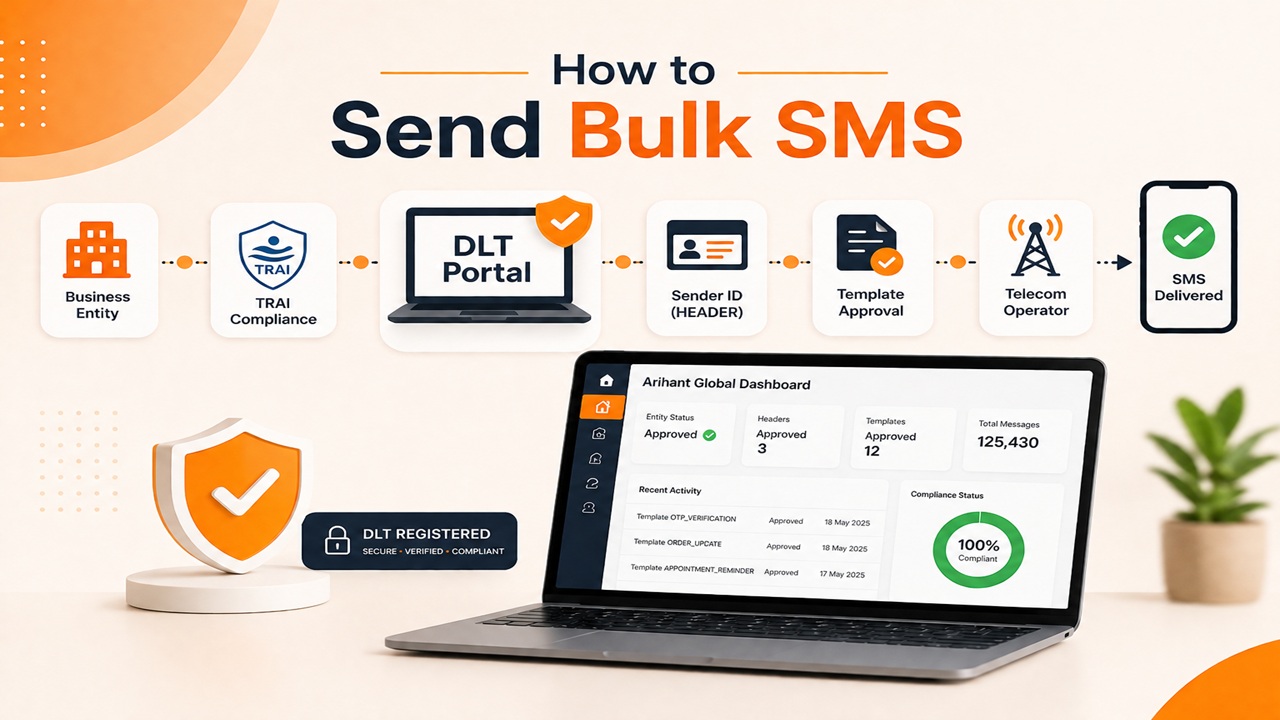
To send bulk SMS in India, you need four things: a CPaaS platform or SMS gateway with direct operator routing, a completed DLT registration under the Telecom Regulatory Authority of India (TRAI) with a verified Sender ID and approved message templates, a clean opted-in contact list cross-checked against the NCPR, and either a web dashboard or an SMS API REST API, HTTP API, or SMPP to trigger your sends. Miss any one of these and your campaign fails silently. Not with an error. Just a Delivery Report (DLR) showing 31% and no explanation of where the other 69% went.
Why Send Bulk SMS Still Outperforms Every Other Channel
Open rates for bulk SMS in India consistently exceed 90% not on a good campaign, but as a sustained baseline. Email averages 21–26%. WhatsApp broadcasts depend on internet access. Push notifications get disabled the moment users feel annoyed. SMS reaches a customer on the device they already have open, through a channel requiring zero internet connection, zero app download, and zero active data plan.
That universality is what makes bulk SMS irreplaceable not a legacy channel being retired, but the reliable floor that every richer channel sits on. Businesses running omnichannel strategies combining Bulk SMS in India with RCS Business Messaging, WhatsApp Business API, and Voice OTP treat SMS as the non-negotiable baseline. When an RCS-enabled handset cannot receive a rich media card, SMS delivers.
Use cases span the full customer journey – promotional flash sales, OTP-based two-factor authentication, appointment reminders, order confirmations, EMI payment alerts, delivery tracking, event notifications, and post-purchase feedback. Every one can be automated, segmented, and tracked through a modern CPaaS platform.
The Four Non-Negotiables Before You Send a Single Message
1. A CPaaS Platform or Bulk SMS Gateway With Direct Carrier Connectivity
The SMS gateway is the engine beneath everything the infrastructure that accepts your message, routes it through contracted carrier connections, and returns a Delivery Report (DLR) confirming what happened at the recipient’s handset.
A gateway with direct contracted routes into Jio, Airtel Business, and Vodafone Idea means your message travels one hop from the CPaaS platform into the operator’s network. Platforms routing through wholesale aggregators add intermediary hops each a failure point, a source of latency, and a place where DLR data gets diluted or lost. Routing quality determines delivery rate more than message copy, send timing, or list size combined. Evaluate every CPaaS provider on direct carrier access first.
2. DLT Registration Under TRAI Mandatory, No Exceptions
The Telecom Regulatory Authority of India (TRAI) introduced the Distributed Ledger Technology (DLT) framework in 2019 to eliminate commercial SMS fraud at the network level. Every business sending commercial SMS in India must complete three registrations on a TRAI-approved DLT portal.
Entity registration verifies your business as a legitimate commercial sender, requiring PAN, GST certificate, authorized signatory letter, and address proof. Sender ID registration files the 6-character alphanumeric header recipients see in place of a phone number for example, AGSIPL or HDFCBK under the correct TRAI category. Template registration submits every message format you plan to send, with variable placeholder positions defined exactly as they appear in live sends.
A message arriving at Jio, Airtel Business, or Vodafone Idea that does not match a pre-approved DLT template tied to a verified entity and valid Sender ID is blocked at the network layer silently, with no notification to the recipient and no error to the sender. This is not a glitch. It is the system working as designed.
3. An SMS API REST API, HTTP API, or SMPP
If your business needs to fire an OTP at user login, push a shipping update when an order leaves the warehouse, or trigger a payment reminder on an EMI due date, you need an Bulk SMS API connecting your existing systems directly to the SMS gateway.
A REST API or HTTP API works over HTTPS, accepts JSON or XML payloads, and suits web applications, CRMs, e-commerce backends, and modern SaaS tools. It handles most business use cases OTP delivery, transactional alerts, event-triggered sends with minimal integration overhead. SMPP (Short Message Peer-to-Peer) is a binary protocol connecting directly at the carrier layer, built for environments where REST API latency is unacceptable. Banks, large NBFCs, and high-volume OTP platforms run SMPP when pushing millions of messages per hour. For most businesses, REST API or HTTP API is the right starting point. Moving to SMPP is a volume and engineering decision, not a features one.
A Clean Contact List Verified Against the NCPR
The National Customer Preference Register (NCPR) also called the DND registry is TRAI’s database of subscribers who have opted out of commercial communications. Sending promotional SMS to an NCPR-registered number is a direct TRAI violation, not simply a delivery failure. List hygiene beyond NCPR means removing duplicates, standardizing all entries to E.164 format (+91XXXXXXXXXX for Indian numbers), and eliminating invalid or inactive numbers before upload. The contact list is the audience targeting layer every campaign result is built on.
How to Send Bulk SMS: The Step-by-Step Process
Step 1: Choose a CPaaS Provider With the Right Infrastructure
Look for three things before price: delivery rate transparency per-operator DLR breakdowns across Jio, Airtel Business, and Vodafone Idea separately, not aggregate figures DLT compliance support covering entity registration, Sender ID filing, and template submission, and REST API or SMPP documentation quality, which reliably signals overall platform maturity.
Step 2: Complete DLT Registration Well Before Your Campaign Date
Submit entity registration through an operator-linked TRAI DLT portal. Entity registration clears in 24–48 hours with complete documentation. Template approval varies: routine templates clear in under an hour; complex variable structures take 24–72 hours. During Diwali and major sale periods, Jio, Airtel Business, and Vodafone Idea portal queues extend further. Submit all DLT templates at least two to three weeks before any major campaign date.
Sender ID category matters critically. TRAI defines two commercial categories: Transactional for OTPs, account alerts, and service notifications, which can reach NCPR-registered numbers and Promotional for marketing content, which cannot. Using a Transactional Sender ID for promotional sends is a TRAI violation that can trigger header suspension, taking down every send on that ID including legitimate OTPs.
Step 3: Clean Your List Before Any Campaign Work Starts
Upload your full contact database to your platform’s validation tool before writing any copy. Standardize to E.164 format. Remove duplicates and invalid entries. Cross-check all promotional numbers against the NCPR. Segment the verified list by behavior, purchase history, or geography. This is the audience construction step that all downstream performance is built on.
Step 4: Write SMS Copy Built for 160 Characters
Lead with the most important element the offer, the action, the deadline not a brand name or greeting. Include a TRAI-mandated opt-out instruction on all promotional messages. Keep URLs short. If your approved DLT template uses variable fields for a customer name or order number, run a test send first. A message opening with {#var#} because a variable mapping broke silently cannot be recalled from 50,000 handsets.
Step 5: Schedule Campaigns or Automate Sends via API
For scheduled campaign sends, peak engagement windows for Indian consumers fall in late morning (10–11 AM) and early evening (5–7 PM) on weekdays. For transactional and event-triggered messaging via REST API or SMPP, delivery speed is the priority. A well-configured Bulk SMS gateway returns an API acceptance response in under a second. The Delivery Report (DLR) confirming handset delivery follows asynchronously within seconds under normal Jio, Airtel Business, or Vodafone Idea network conditions.
Step 6: Read Your DLR Data Not Just the Headline Number
A platform showing 94% “delivered” without breaking down the remaining 6% by DLR reason code gives you a number you cannot act on. Delivery Report data by error code separates a list quality failure (invalid-number rejections) from a DLT compliance block (Sender ID or template mismatch) from a carrier routing failure on a specific Jio or Airtel Business circle. Three problems, three different fixes. Teams watching only aggregate delivery run structurally broken campaigns for months before understanding why.
The Mistakes That Kill Campaigns Silently
Mistakes That Come Up Way Too Often
- Skipping DLT or Sender ID registration, then wondering why nothing’s getting delivered
- Cramming messages with links, emojis, and jargon nobody asked for
- Ignoring opt-out requests (which can turn into real compliance trouble)
- Buying third-party lists instead of building one people actually opted into
- Never checking the analytics, so the same mistakes repeat every single time
Frequently Asked Questions – Send Bulk SMS
Q1. What is TRAI’s role in bulk SMS?
The Telecom Regulatory Authority of India (TRAI) governs all commercial SMS under the Telecom Commercial Communications Customer Preference Regulations. TRAI mandates the DLT framework, defines Sender ID categories, maintains the NCPR, and sets compliance rules every sender must follow. Non-compliance means silent message blocking at the Jio, Airtel Business, and Vodafone Idea network level.
Q2. Is DLT registration mandatory for every sender?
Yes, without exception. Every commercial sender must register as a verified entity on the TRAI DLT platform, register all Sender IDs under the correct category, and get every template approved before use. Unregistered messages are blocked at the operator level no error, no retry, no delivery.
Q3. What is the difference between REST API, HTTP API, and SMPP?
REST API and HTTP API work over HTTPS and suit most use cases OTPs, transactional alerts, and CRM-triggered sends. SMPP is a binary protocol for very high throughput, preferred by banks and OTP platforms sending millions of messages hourly. Most businesses start with REST API and move to SMPP only when volume demands it.
Q4. What is a Delivery Report (DLR)?
A Delivery Report (DLR) is the confirmation returned by the Bulk SMS gateway after a message reaches or fails to reach a handset. It contains a status code and, on failure, a reason code identifying whether the cause was a DLT compliance block, invalid number, NCPR rejection, or network congestion. DLR data by reason code is the only reliable way to diagnose delivery failures accurately.
Q5. What is the NCPR and why must I check my list against it?
The National Customer Preference Register (NCPR) is TRAI’s DND database of subscribers who have opted out of commercial communications. Sending promotional SMS to NCPR-registered numbers is a TRAI violation with regulatory consequences beyond poor delivery. All promotional lists must be verified against the NCPR before every send.
Final Thoughts
None of this is rocket science once you see the pieces laid out. the right Cpaas platform, proper registration, a clean list, and messages that don’t waste anyone’s time. Get that right, and SMS quietly becomes one of the best-performing channels you have, mostly because people actually read texts within minutes of getting them.
If you’d rather have this whole process Sender ID setup through to delivery tracking handled with a proper compliance framework already in place, that’s exactly what Arihant Global offers.
Want your next bulk SMS campaign set up the right way DLT registration, delivery reporting, all of it?
Get in touch with Arihant Global and get started.